
This simple grid-based cipher will have you babbling apparent nonsense to send out secret messages.
Gobbledigook
What we are doing in this edition is essentially taking the concept of a Polybius Square cipher (as seen in a previous edition — ERA Mag Apr23 — or knock code, but instead of being left with pairs of numbers, we will have pairs of letters that can actually be read out loud to form what seem like words.
Firstly set out all the alphabet in a five by six grid (below we’ve thrown in some punctuation just to fill the space). Then frame it with the five vowels above and below (on the x axis), and choose six consonants for the left and right (on the y axis). The order of these sets of letters is not important, but it is best to chose consonants that are very distinct (maybe avoid using both ‘G’ and ‘J’ on the same grid).
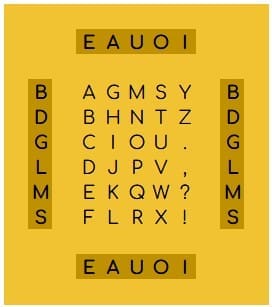
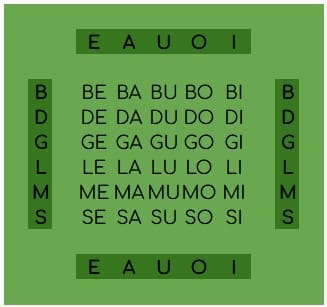
Each letter is then represented by a pair of letters like this:
Singing Like A Lunatic
Let’s use ‘babble’ as our example. First find ‘B’ on our grid, which is at the intersection of ‘D’ and ‘E’, giving us B=DE. ‘A’, just above it, gives A=BE. Completing the rest of the word gives us this:

So to convey the word ‘babble’ we can say the totally-nonsensical-but-totally-plausible-as-words DEBEDEDESAME. Which, obviously, we would read out as “dee bee dee dee saa mee”. It is crucial to this cipher that we enunciate each two-letter reference as a separate syllable and not try and blend them together. So don’t read this message out as “deeb deed same” or something like that.
Buzzing In Our Ears
To decipher, we need to take any syllable presented and separate it back into its consonant and vowel parts to give the grid reference.
Have a go at decoding this handsome fellow:

Endless Play
As this concealment method lends itself to the auditory format, be alert for spoken messages in your Escape Room. As always, a guide will be provided somewhere, and in this instance you should also get some writing material to take notes. Hopefully any designer using this also makes a distinction between vowel sounds: will ‘SI’ sound like ‘see’, ‘sigh’ or a Spanish ‘si’? Will ‘GU’ sound like ‘guh’ or ‘goo’?
Here’s one for you to figure out with our grid above:

Happy escaping!